2000–2009: Rooting the Organization
How the Grassroots Fund carved a pathway for a community centered grantmaking model while evolving its definition of environmental justice.
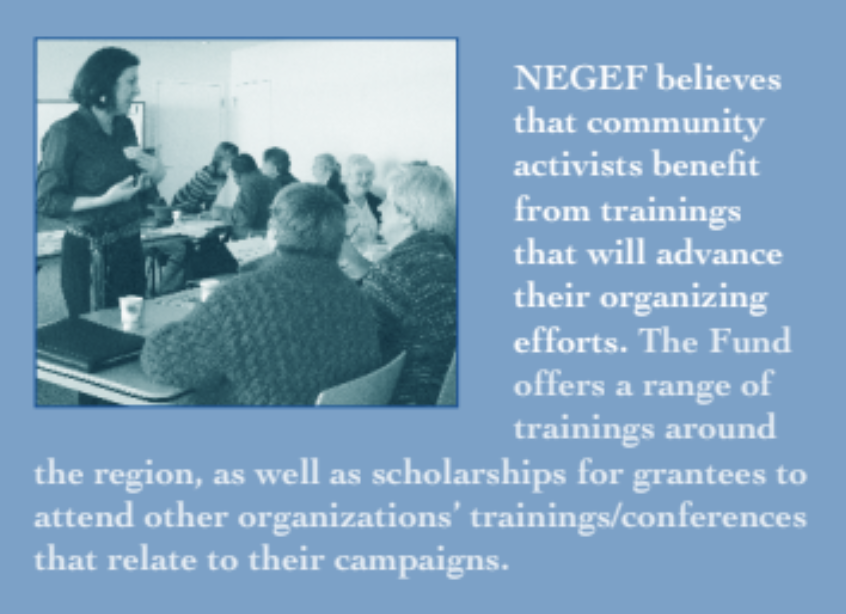
The next decade was about proving the experiment could stand on its own. The New England Grassroots Environment Fund become an independent 501(c)(3) non-profit organization,, formalizing its identity as a public intermediary fund rather than a project housed inside a larger institution. With independence came room to grow: the organization expanded its geographic reach to include southern New England and rolled out early signature programs, including the Rootskills Workshops: hands-on skill-building sessions for grassroots organizations, and regional efforts like the Boston Grants Initiative, which pushed participatory grantmaking into New England's largest city.
This period marks a shift from experimental funder to established infrastructure for grassroots environment work.The organization scaled grantmaking significantly, reaching over a thousand grants distributed across hundreds of community groups. At this time, funding grassroots organizations through community led processes was not something that had entered the mainstream narrative of traditional philanthropy.
Growth did not mean stability, however. For all the impact grassroots grantmaking was clearly having, it remained a hard sell to traditional funders looking for long-term commitments, and financial strain forced the organization to skip grant rounds in both 2007 and 2010. Through it all, the Fund kept refining its approach and, crucially, kept widening its own definition of what counted as “environmental” work. The team was learning, often directly from grantees, that the line between environmental health, public health, and social justice was far blurrier than organizational leadership had previously understood.

“I'm proud that we believed in grassroots leadership when many funders didn't. Too often, foundations overlooked small neighborhood groups in favor of larger, established organizations. But we saw the power of people closest to the problems. We funded emerging leaders, unincorporated groups, and organizations that others wouldn't support because we believed real change starts in communities.
When I look back on the Grassroots Fund's journey, what stands out most is how much we learned from the communities we supported. In the early days, our definition of environmental work was much narrower.
I remember a conversation about a group working on lead paint issues, and someone said, "That's a health issue, not an environmental issue." The response was immediate: "We've got a lot of work to do." Looking back, that moment captured a larger truth. We were still learning what communities already knew: that environmental issues are deeply connected to health, justice, and everyday life.
Over time, we came to understand environmental justice not as a separate issue, but as central to the work. In many ways, communities were teaching us how to expand our vision.
What made the Grassroots Fund unique wasn't just where the money went. It was our willingness to listen, adapt, and share power. The people doing the work helped shape the organization itself. Not any single grantee, but a network of people and communities that found one another, grew together, and helped redefine what the work could be. The Grassroots Fund didn't just support change. The communities we funded changed us, too.”
– Cheryl King Fischer, Executive Director (1996-2012)